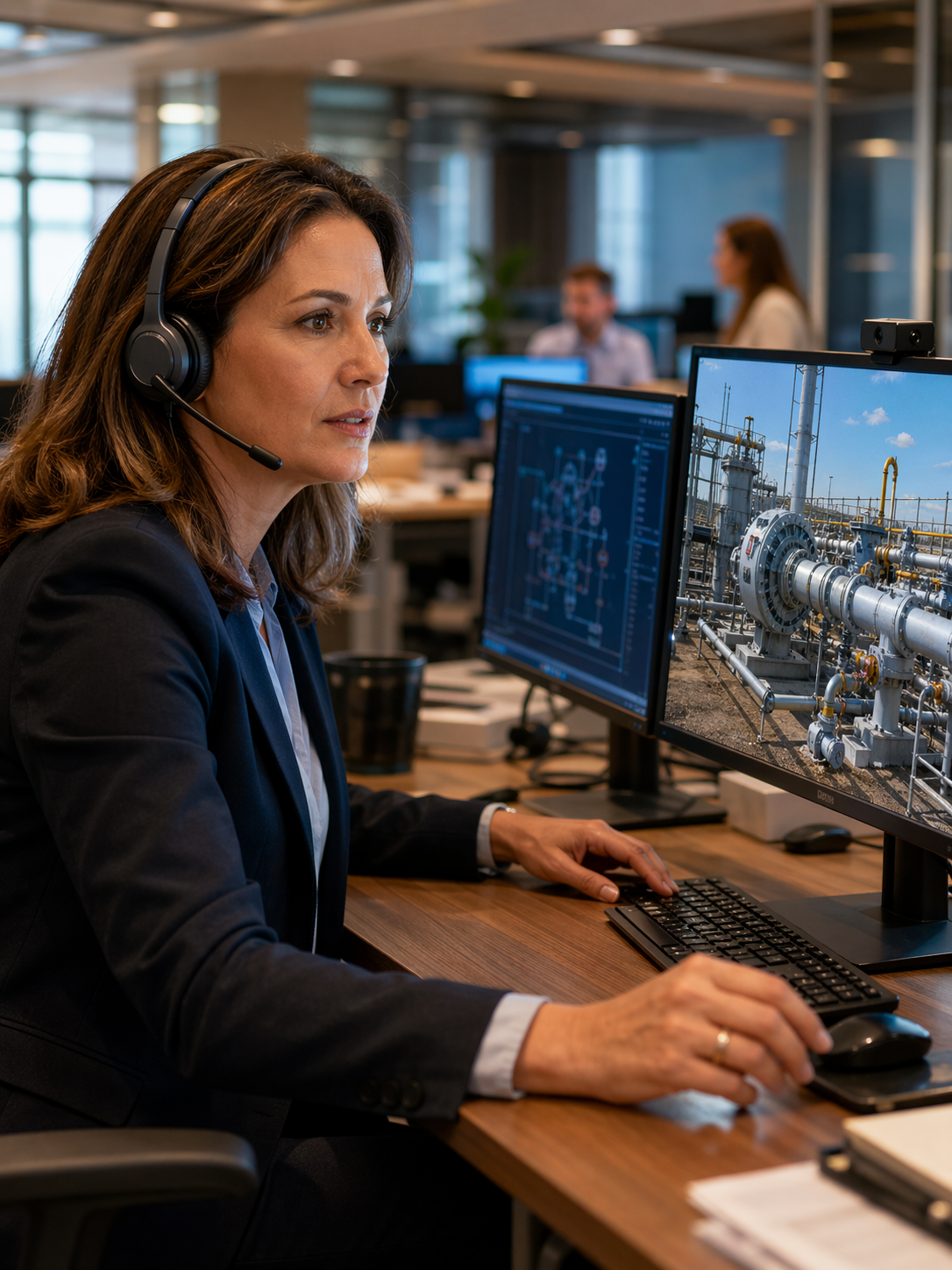
CMMS was designed for asset record-keeping and maintenance scheduling — not real-time frontline execution. The core failure is a mismatch: CMMS systems serve planners and administrators, while frontline technicians need live, contextual, step-by-step task guidance. Connected worker platforms like Telepresenz close this gap with digital SOPs, remote expert support, and real-time task intelligence — without replacing your CMMS.
The Gap Between the Work Order and the Work
A field technician at a remote substation receives a work order through the company CMMS at 6:47 AM. The order says: "Inspect transformer unit T-14." That's it.
No step-by-step procedure. No visual reference. No indication of which safety checklist applies. No way to escalate to a remote expert if something looks off. And certainly no mechanism to flag in real time that the task was completed safely and in compliance.
The technician relies on memory, experience, and whatever paper SOPs they printed last quarter — which may or may not reflect the latest revision.
Meanwhile, back in the control room, the CMMS shows the work order as "In Progress." Everything looks fine on the dashboard. But on the ground, execution is fragile, undocumented, and entirely dependent on one person's knowledge on one particular morning.
"This is the frontline execution gap — and it's not a small inefficiency. In utilities, energy, and critical infrastructure, this gap is where downtime originates, where compliance failures are born, and where institutional knowledge quietly walks out the door."
Telepresenz is built to close this gap — not by replacing your CMMS, but by doing what it was never designed to do: guide the work itself.
What Is a CMMS — and What Was It Actually Built For?
A CMMS (Computerized Maintenance Management System) is a software platform designed to schedule, track, and record maintenance activities and asset data — not to guide frontline workers through task execution in real time.
CMMS platforms emerged in the 1960s and 70s as digital replacements for paper-based maintenance logs. Their core job was — and largely still is — to answer three questions: What assets do we have? When do they need maintenance? Was that maintenance completed?
This makes CMMS genuinely valuable for asset lifecycle management, preventive maintenance scheduling, inventory control, and work order generation. The problem arises not from what CMMS does, but from what operations teams have been forced to ask it to do — namely, run field execution.
The fundamental misunderstanding: When the work order leaves the CMMS and lands in a technician's hands, the CMMS's job is essentially over. It cannot tell the technician how to do the job. It cannot adapt if conditions on the ground differ from what was anticipated. It cannot connect the technician to a remote expert, surface the right revision of the right procedure, or confirm that each critical step was completed correctly before the next one begins.
Why CMMS Systems Fail Frontline Execution
CMMS systems fail frontline execution because they are passive record-keeping tools assigned an active execution role they were never designed to fill. The failure is structural, not incidental — you can upgrade a legacy CMMS to the cloud, give it a mobile interface, and bolt on a reporting dashboard, and the execution gap will still exist.
1. Built for Planners, Not Technicians
A CMMS is designed from the perspective of a maintenance manager sitting at a desk. It optimises for scheduling visibility, asset history, and work order management. A field technician needs granular, step-level task guidance — ideally delivered at the point of work, on a device that works in poor lighting, with gloves on, fifty feet up a utility pole. Even modern CMMS mobile apps remain primarily data-entry tools, not execution aids.
2. No Real-Time Task Orchestration
Traditional CMMS systems generate a work order and then wait. They have no mechanism to monitor whether a task is being performed correctly in real time, flag a deviation, escalate to a supervisor, or dynamically update task steps based on what the technician actually finds. In high-stakes environments like power generation or water treatment, this passive model is a liability.
3. Poor Mobile and Offline Usability
Field technicians routinely work in areas with limited or no connectivity — underground vaults, remote substations, offshore platforms. Most CMMS systems require a live connection to function. When connectivity drops, so does access to work orders, procedures, and documentation. The technician reverts to memory or paper, eliminating the value of the digital system entirely.
4. No Contextual Knowledge Delivery
A CMMS records that a task was done. It almost never captures how to do it — particularly for complex, infrequent, or high-risk tasks. Procedure documents, safety checklists, equipment manuals, and visual references typically live in separate systems (or filing cabinets). The cognitive burden of cross-referencing all of this falls entirely on the technician, which is where errors begin.
5. Reactive, Not Predictive
Most CMMS platforms are fundamentally reactive — they track failures and log completed maintenance. While some newer systems incorporate basic predictive maintenance features, they rarely deliver that intelligence to frontline workers at the moment it matters: right before a task begins. The result is that technicians are often the last to know when something is trending toward failure.
Core CMMS Limitations in Real-World Operations
Move from the planning room to the plant floor, and the theoretical strengths of a CMMS quickly collide with operational reality.
Is CMMS Enough for Frontline Operations in Utilities?
No. The regulatory complexity, geographic dispersion, asset criticality, and real-time execution demands of utility operations exceed what any maintenance record system can support on its own.
Utilities occupy a unique position in the CMMS limitations conversation. Their operational context amplifies every gap:
- Regulatory pressure is constant and granular. Utility operations are governed by NERC CIP, OSHA 1910, and utility-specific safety protocols that require evidence not just that work was done, but that it was done correctly, safely, and in full compliance with documented procedure.
- Assets are geographically dispersed and often in remote or hazardous environments. Sending technicians to substations and generation facilities without reliable execution support — visual guidance, remote expert access, offline-capable digital SOPs — creates operational risk that no scheduling system can mitigate.
- The skills gap is accelerating. A significant portion of the skilled utility workforce is expected to retire within the next decade. The knowledge and judgment experienced technicians carry is irreplaceable unless systematically captured and made accessible — something CMMS systems are not built to do.
- Downtime consequences are asymmetric. In utilities, a maintenance failure can mean grid outages affecting thousands of customers, regulatory penalties, and serious safety incidents. The cost-benefit calculation for proper execution infrastructure is clear.
CMMS vs Workflow Automation: What's the Real Difference?
CMMS manages maintenance records and schedules. Workflow automation manages the execution of work itself — step by step, in real time, at the point of task.
This distinction is frequently misunderstood. The critical insight is that these two categories are not competitors — they are complements. A CMMS is excellent at managing asset data, scheduling preventive maintenance, and generating work orders. A connected worker platform picks up where the CMMS ends: the moment a technician begins performing actual work.
| Dimension | CMMS (System of Record) | Connected Worker Platform (System of Execution) |
|---|---|---|
| Primary function | Schedule, track, and record maintenance | Guide, validate, and document field execution in real time |
| Designed for | Planners and maintenance managers | Frontline technicians at the point of work |
| Task guidance | Work order title and description | Step-by-step digital SOPs with validation gates |
| Connectivity | Online required | Offline-first, syncs on reconnection |
| Compliance capture | Work order closed/open | Step-level evidence, multimedia, geolocation, timestamp |
| Expert access | None | Live video escalation with AR annotation |
The mature approach: Deploy both. CMMS as the system of record, and a connected worker platform as the system of execution. Organisations that conflate the two end up asking their CMMS to do something it structurally cannot do — and they pay for that misalignment in operational inefficiency, safety incidents, and compliance gaps.
What's Better Than CMMS for Utilities and Field Teams?
Connected worker platforms — which combine digital SOPs, AR-guided workflows, remote expert access, and offline capability — are the purpose-built solution for frontline execution gaps that CMMS cannot address. The answer is not to replace your CMMS. The answer is to extend it with an execution layer designed specifically for the people doing the work, in the conditions where they actually do it.
1. Digital SOPs and Step-Level Guidance
Instead of a flat text work order, the technician receives a structured, step-by-step digital procedure with embedded visual references, safety checkpoints, and validation gates. Each step must be confirmed before the next one unlocks. This eliminates reliance on memory and paper — and generates a real-time compliance record simultaneously.
2. Augmented Reality Work Guidance
For complex, high-risk, or infrequent tasks, AR overlays provide visual guidance anchored to the physical asset — showing the technician exactly what to inspect, where to connect, and how to sequence actions. This capability is transformative for organisations managing workforce transitions, where experienced technicians are being replaced by newer workers who lack contextual asset knowledge.
3. Remote Expert Support
When a technician encounters something unexpected, they should not be left to guess. A connected worker platform enables instant escalation to a remote subject matter expert, with live video, AR annotation, and shared view — so the right knowledge reaches the right place in seconds, not hours. For geographically dispersed utility operations, this capability alone can eliminate entire categories of delay and error.
4. Offline-First Architecture
Effective frontline execution cannot be contingent on connectivity. A purpose-built connected worker platform stores all task data, procedures, and references locally on the device, syncing when connectivity is restored. This ensures the technician has everything they need regardless of where the work takes them.
5. Knowledge Capture at the Point of Work
Every completed task, annotation, deviation, and escalation becomes structured data. Over time, this builds a dynamic knowledge base anchored to specific assets, procedures, and failure modes — the institutional memory that CMMS systems have never been able to capture.
How Telepresenz Bridges the Frontline Execution Gap
Telepresenz is a connected worker platform built specifically for the environments where CMMS limitations are most acute: utilities, energy, manufacturing, and critical infrastructure. It sits as an execution layer above your existing CMMS, turning passive work orders into guided, validated, and documented task workflows.
Here's what it looks like in practice: a work order is generated in your CMMS as normal. When it reaches the technician, Telepresenz transforms it into a structured digital workflow — complete with step-by-step AR guidance, embedded safety checkpoints, and offline access. As the technician works, every step is validated and captured in real time, creating a live compliance audit trail. If they encounter something unexpected, a single tap connects them to a remote expert with shared AR vision. When the task is complete, structured data flows back to the CMMS automatically — no manual entry, no latency, no gaps.
The result is not just better execution. It is a systematic reduction in safety incidents, compliance risk, unplanned downtime, and knowledge loss — the four dimensions of operational cost that legacy CMMS architectures have never been able to address.
Conclusion
The story of CMMS limitations is not a story of bad technology. It is a story of the wrong tool being asked to do the right job.
CMMS platforms were designed to manage asset records and maintenance schedules — and they do that well. The problem begins when organisations expect them to also guide field execution, enforce step-level compliance, deliver contextual knowledge, and support real-time operations. These are execution problems, and they require execution tools.
For utilities, energy, and industrial operations managing complex assets in dispersed, regulated, high-stakes environments, the frontline execution gap is not a theoretical concern. It shows up in incident reports, audit findings, unplanned outages, and the quiet departure of tribal knowledge every time an experienced technician walks out the door for the last time.
The path forward is not to keep patching a system that was built for a different job. It is to pair your CMMS with a connected worker platform that does what it was never designed to do: be present on the frontline, at the asset, at the moment the work happens. That is precisely where Telepresenz operates.