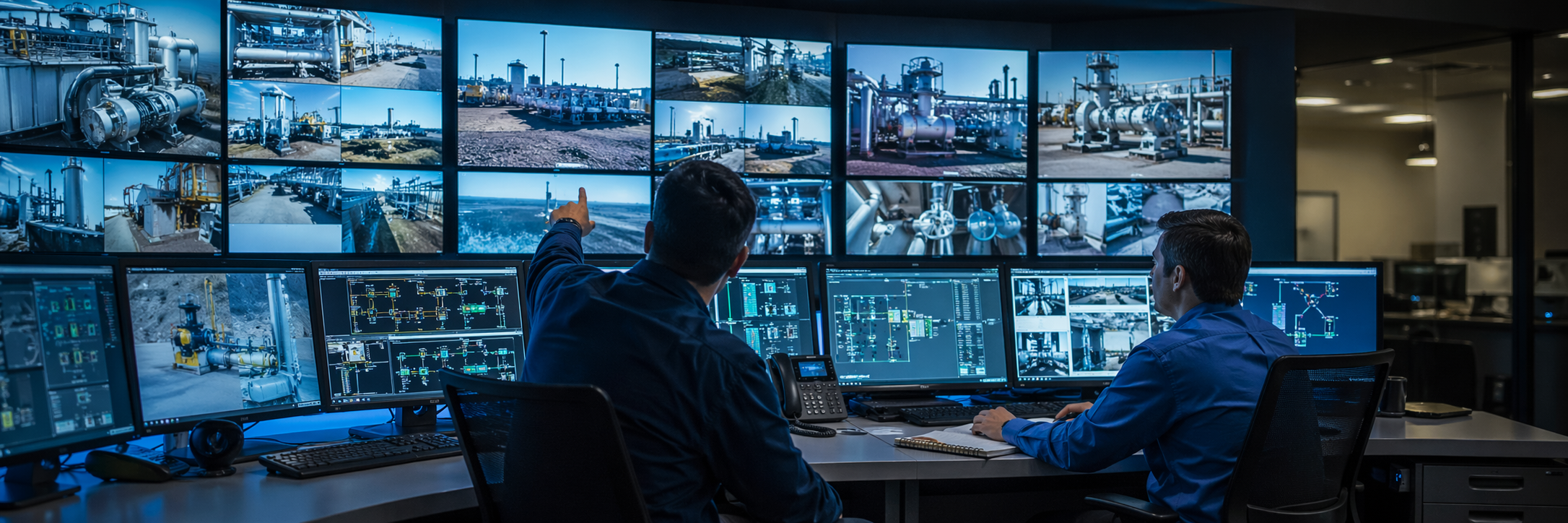
Remote operations centre: 15 stakeholders can observe a field investigation simultaneously — without travelling to site.
Any time there is a mechanical failure of a certain grade, an investigation team is assembled. In a traditional field service operation, this means 15 people — engineers, safety managers, client representatives, corporate stakeholders — converging on a single location to observe a disassembly. The travel logistics alone can take days. The cost is significant. And every person who travels is a person who has dropped everything else they were doing. Remote observation changes this equation entirely.
Why Equipment Failure Investigations Require So Many People
A formal investigation into a significant mechanical failure is not simply a technical exercise. It is a legal, safety, and commercial process. Multiple parties have a legitimate interest in witnessing the disassembly and inspection: the service company needs to understand the failure mode; the client needs to satisfy their own HSE and insurance obligations; corporate management needs visibility for risk reporting; and in some cases, regulatory bodies or independent experts need to be represented.
Each of these parties has historically needed to be physically present because there was no reliable way to give them the same quality of observation remotely. A phone call cannot convey what an expert eye looking at a worn bearing surface needs to see. A report written after the fact cannot replace witnessing the condition of components as they are removed.
Remote assistance changes both of these constraints.
What Remote Observation Enables That Wasn't Possible Before
1. Real-Time Multi-Party Witness
With a live video session, 15 people can observe the same disassembly simultaneously — each from their own location. The expert on-site positions the camera, narrates the condition of each component, and responds to questions from remote observers in real time. Every participant sees exactly what the on-site team sees. No detail is filtered or summarised by a report author working from memory.
2. Annotated Evidence Capture
As components are removed and inspected, the on-site team captures timestamped photos and video. Remote experts can annotate the live feed — circling wear patterns, highlighting anomalies, marking measurements. These annotations are saved with the session record, creating a contemporaneous evidence log that is more detailed and more reliable than any retrospective report.
3. Immediate Cross-Functional Input
In a physical investigation, the metallurgist, the client HSE representative, and the corporate risk manager are rarely all present at the same time. Remote observation removes the scheduling constraint. All parties join the same session. Questions are answered in real time. Findings are discussed as they emerge, not reconstructed three weeks later in a meeting room.
"If 15 people could observe a disassembly with just 1 or 2 people on location, that would save these companies enormous travel time and idleness. That's the value I see."
The Hidden Costs of Physical Presence Requirements
Travel and Accommodation
For an investigation team of 15 assembled from multiple locations, travel and accommodation costs quickly exceed the direct cost of the failed component. Flights, hotels, car hire, and the administrative overhead of coordinating 15 travel itineraries represent a significant and largely invisible investigation cost.
Productivity Loss
Each person who travels to the investigation site drops their other responsibilities for the duration. Senior engineers, safety managers, and client representatives are typically the people with the most competing demands. A three-day investigation trip removes them from their normal roles for the entire period — including travel days before and after.
Scheduling Delay
Assembling 15 people at one location takes time. Coordinating 15 travel schedules across multiple organisations — service company, client, corporate — introduces days or weeks of delay before the investigation can begin. Every day the failed equipment remains disassembled is a day the root cause analysis is postponed and the corrective action is delayed.
The compounding effect: Investigation delay means corrective action delay. Corrective action delay means the same failure mode may recur at another site before the root cause is identified and addressed. The cost of the second failure — and any subsequent incidents — should be attributed in part to the logistical friction of the first investigation.
How to Structure a Remote Investigation
Remote equipment failure investigation is not simply a physical investigation with a camera pointed at the work. It requires deliberate structuring to deliver the quality of evidence and stakeholder confidence that a formal investigation demands.
On-Site Requirements
A remote investigation requires a minimum of two people on-site: one to perform the disassembly, and one to manage the camera, communication, and documentation. The camera operator is a skilled role — they must know what to capture, how to frame components for expert assessment, and how to respond to requests from remote observers. This is not a task that can be delegated to the most junior person available.
Remote Session Structure
The investigation session should have a designated facilitator — typically the lead engineer or safety manager — who manages the flow of the remote session, queues questions from remote observers, and ensures all parties have the opportunity to examine relevant findings before the investigation moves on.
- Pre-session briefing: all remote participants are briefed on the failure description, the expected disassembly sequence, and the evidence they need to validate
- Live narration: the on-site team narrates every step, component condition, and measurement as the disassembly proceeds
- Annotation and capture: key findings are annotated on the live feed and automatically saved with timestamps
- Real-time Q&A: remote observers raise questions directly, the on-site team responds and captures additional evidence as needed
- Session close: the platform generates a complete timestamped record of the session, including all photos, annotations, and chat log
Legal and Compliance Validity
A legitimate concern for investigation teams is whether remote observation satisfies the legal and regulatory requirements for witness presence. In most jurisdictions, what matters is the quality and integrity of the evidence — not the physical location of the observer. A timestamped, annotated video record with multiple authenticated witnesses is typically more defensible than a retrospective written report from people who were physically present but whose recall may differ.
For any investigation with regulatory implications, legal review of the remote observation approach should be confirmed in advance with the relevant parties.
Beyond Investigations: The Same Model for Three Levels of Management
The remote investigation model is not limited to formal failure investigations. The same capability enables a broader operational principle: multiple levels of management can provide real-time support to a field technician without anyone needing to travel.
Consider the scenario where a service technician is struggling with a complex repair. Historically, the chain of support required sequential physical visits: the technician calls their supervisor, the supervisor calls the engineer, the engineer eventually travels to site. Each step adds delay. Each physical visit adds cost. And the technician is stuck in the meantime.
With remote assistance, three levels of management can join the same session simultaneously. The supervisor sees what the tech sees. The engineer sees what the supervisor sees. The safety director can observe without interfering. The right expertise reaches the right problem immediately — and every interaction is documented automatically.